
HISTORY
The Buckhorn Mineral Springs property is listed on the National Register of Historic Places, reflecting a long history of gathering, healing, and connection to this remarkable landscape.
The History of The Land Known As Buckhorn Springs
For thousands of years the mineral springs along the Rogue River Valley have been used for healing by the Takelma, Shasta, Klamath and Modoc peoples long before there was any European settlement. Buckhorn Springs CO2 vapor spring was used by the native people for healing. These tribes considered this land and the springs sacred.
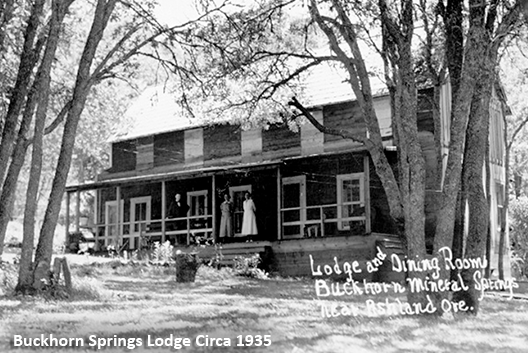
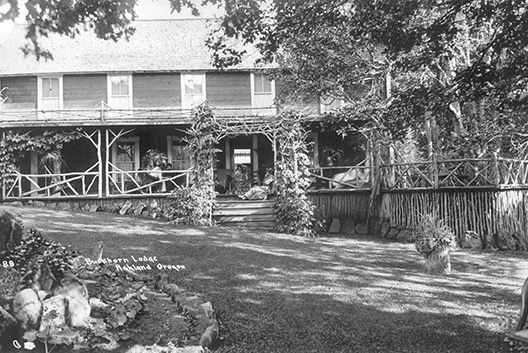
In the early 1800s, European settlers and travelers began to explore the Rogue River Valley. The area became a popular spot for healing due to the numerous local mineral springs and the curative properties they provided. Settlers soon learned about the mineral springs located at Buckhorn from the local tribes. A man named James Tolman purchased the property in 1890 from Dr. Caldwell, and decided to develop the land in the area around the mineral springs. He built the first lodge for travelers on the property.
Buckhorn Springs became a destination for settlers and travelers who came to experience the mineral springs and natural beauty of the area. During the early 1900s, visitors traveled there for mineral baths and the restorative qualities of the springs. In the 1950s, Dr. Wexler, one of the many owners, purchased the property and operated a health spa, offering hydrotherapy treatments and attracting guests seeking healing and renewal.
Since the mid 1800s , Buckhorn Springs has passed through many owners, each contributing to the story of the property in their own way; however, by the 1980s, many of the buildings at Buckhorn had fallen into disrepair and much of Buckhorn's history was in danger of being lost.
That changed in October 1987 when Bruce and Leslie Sargent purchased the aging property. While many saw a collection of rundown buildings, the Sargents saw something worth preserving. Reflecting on his first encounter with Buckhorn, Bruce remarked, "Ninety-nine out of one hundred people would have torn it all down. But I kind of like old things."
Once Bruce and Leslie realized that restoring the health spa was unrealistic, they decided to preserve the past rather than recreate it. What began as a family project soon became a life's work—restoring historic structures, protecting the surrounding habitat, and honoring the stories woven into this landscape.
Where visitors took mineral baths in the 1930s and received hydrotherapy treatments from Dr. Wexler in the 1950s, today's guests find historically restored accommodations, beautiful scenery, fresh air, and the soothing sound of Emigrant Creek. Many of the qualities that attracted visitors a century ago continue to draw people to Buckhorn Springs today: a sense of peace, connection, and renewal rooted in the land itself.

Indigenous People at Buckhorn, 1800 – 1900
Long before the white man came to this country, so long ago, in fact, that Indian tradition does not fix the date, that wonderful collection of mineral springs that promises soon to make Ashland famous, was known and valued by the aborigines for their medicinal properties.
I first visited these springs 44 years ago, and more than 40 years ago published a prophecy that sometime a great health and watering resort would be built here.
I had then only recently arrived from my home in the prairies of Illinois, and everything I saw was new to me and wonderfully interesting, the mountains, the forests, the game and the Indians, were a delightful study for me. I went among the Indians east and west of the Cascade Mountains and learned many things not published in newspapers and books. When I came Jackson County comprised all that area now known as Jackson, Klamath and Lake Counties, and did not contain as many white people by one third as the city of Ashland has now. (Dec. 31, 1914)
The country now embracing Klamath and Lake Counties was known as the “Lake Country”, and by the Indians as the “Land of Many Lakes”.
It was inhabited by mainly by the Klamath and Modoc Indians, two powerful and war-like tribes, often engaged in war with each other, but sometimes by treaty combining to fight with the tribes west of the Cascades, also a war-like people, later known as the Rogue River Indians. These last were however, so depleted by the wars of 1855 and 1856 that they ceased to be a menace to the Lake tribes.
When I first came there were stories about the aborigine’s use of the mineral springs, especially those known as the Tolman springs, now owned by Mr. Lawrence and known as the “Buckhorn Lodge”, the escaping gases of which were prized by the Indians as “Hi-U- Skookem Medicine”. I visited them and verified some of the stories told. There were the places hollowed out on the banks of the streams where the gases escaped through fractures in the rocks, excavated by the Indians, in which they treated their patients. Dead birds, squirrels, snakes, rats and other small animals and reptiles lying in those pits told of the deadly qualities of the carbonic acid gas when not used with caution. In fact, the same thing may still be seen about these vents. From these facts the early settlers called them “poison springs”. The Indians, however, had learned to use them and valued them accordingly.
Their method was to find a spot where the gas escaped, hollow out a sufficient space, spread fir boughs in it for comfort, place the patient on the boughs, where he remained under watchful care until he became unconscious. He was then taken into a “wik-i-up”, or tent made of skins and boughs and there put through a course of manipulation until he recovered consciousness. Then would follow a day or two of sweating and incantations by a medicine man. This treatment was continued until the patient was cured or declared incurable. All this time they drank the waters from the springs and used it for the vapor baths in their sweat house.
The Modocs and Klamaths were very skillful in the manufacture of baskets. Many of them were made for cooking in and for holding water. Those water-tight baskets were filled and hot stones put into them, filling the sweat house with steam almost to the point of suffocation. The treatment was heroic, but the Indians insisted that it seldom failed to cure the most obstinate cases of rheumatism, asthma, kidney disease and stomach trouble. It was not unusual for patients to be strapped onto ponies and brought from distant parts of the “Land of Many Lakes” to be treated.
Forty years ago the old warriors, those that possessed the most wisdom, could seldom be induced to talk on such matters, but I became acquainted with Frank Riddle, who came among these Indians nearly seventy years ago (1844?) took a wife among them and remained until he died a few years ago. Riddle was a man of much intelligence and grew to be a man of much influence among them. During the Modoc war in 1872 and 1873 he and his wife Toby did great services for the Government troops, acting as interpreters and messengers of mediation. Riddle wanted me to write his history, and I agreed to do it if he would prepare the data for me. This he promised to do but never did. Our acquaintance ran through twenty years and he often related his experiences and adventures to me. It goes without saying that his tales were thrilling. I asked him how long the Modocs and Klamaths had used the mineral springs of the upper Rogue River Valley. He said he did not know and the oldest men of the tribes when he first came among them did not know. They were in use then and appeared to have been for ages. The people had a superstition about them and attributed their virtue to the “Great Spirit”. The escaping gas was the breath of the “Great Spirit”, and was a guarantee of a sure cure if the patient had led a worthy life, but sure death if he had not. The place in which the “Great Spirit” chose to administer the benefits of his healing breath was considered sacred, and for ages was supervised by a great medicine man.
Even when the tribes of the “Land of Many Lakes” were at war with the tribes in whose territory these springs were situated, if pilgrims from east of the mountains succeeded in reaching the springs for medical treatment, they were not molested while there, but if they could intercept them before they had passed the great forest they were driven back or killed. In this connection he told me a beautiful romance of two lovers of the dim past. They sought the springs in the hope that the maiden might be cured of a malady that threatened he life. The story would be too long for this article and I may give it at another time.
I asked my friend why the people of the “Land of Many Lakes” always stopped at this one cluster of springs, why they did not go to the others, when there were so many further down in the valley, where the grass was better and no rugged canyon to hedge them in. He said that in that early time of which, in their superstition, they spoke with bated breath, this one cluster of springs had by treaty been granted for their use and they were prohibited from visiting any other.
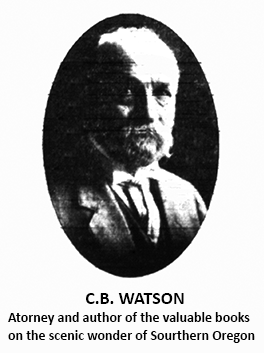
– C.B. Watson
The Tolman Years, 1890 – 1902
The curative powers of Buckhorn’s Carbon Dioxide springs known to the Indigenous People did not go unnoticed by the white settlers, whose numbers increased sharply over the last half of the nineteenth century. Even though many whites may have scoffed at much of what the Indigenous People held sacred, they did take pragmatic notice of any practices that might improve either their health or their pocketbooks. Putting fears of the “poison waters” (small dead animals had been found around the CO2 site in the creek) aside, it was not long before white entrepreneurs began offering their own brand of “Hi-U-Skookum Medicine” to those settlers who found no relief for their ailments elsewhere, medical science being what it was at that time.
In 1854, speculation has it that someone, perhaps Dr. Caldwell, built a homestead cabin next to the springs at Buckhorn and gained title to the property. This two-story structure formed the core for the lodge built several years later by James Tolman. We do know that in the late 1880’s, Dr. Caldwell sold a parcel of land surrounding Buckhorn to a man named Blackwood, who in turn sold it to Tolman in 1890.
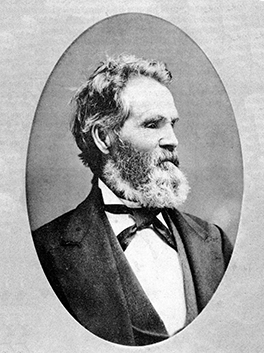
James Clarke Tolman, born in Ohio in 1813, joined the 1849 Gold Rush to California. He returned to Iowa, married Emily Coe in 1852, and two days later, began the arduous journey to Oregon by ox team. Tolman was unique among Ashland pioneers in that he attended college. While in Iowa, he ran for the Territorial Legislature on the Whig ticket, losing by only 60 votes. In 1874, he was nominated as the Republican candidate for Governor of Oregon, but was defeated. Tolman served two terms as Judge of Jackson County and was appointed Oregon’s Surveyor General in 1882. He was also known for raising Morgan and Lionheart racehorses and English turf horses.
By the time the mineral springs outside of Ashland became available for purchase, Tolman had the political and financial clout to strike out in yet another direction…
In 1890, Tolman began the first real development of the springs by starting construction of a hotel built around the original cabin. One of Tolman’s initial acts as the new owner was to give it a name: Tolman Springs. No one knows for sure whether his prime plan for the springs’ use was benevolent, mercenary or both. We do know he opened his pocketbook and spent both time and money developing Tolman Springs into a health resort of wide reputation. By 1900, the springs included the hotel, cottages, and facilities for visitors to bathe in mud, mineral water or CO2 vapor; Tolman expanded the homestead footprint more than fourfold from its original size…
At this time Tolman’s resort was accessible only by stage on a road that wound from Ashland over the Siskiyous past Pilot Rock, then into California. The path of this stage road was most likely influenced by the locations of Tolman Springs and Wagner Soda Springs, two miles down the road. Oddly enough, Southern Pacific, which earlier helped promote Tolman Springs, later contributed to its demise when the railroad chose to route its tracks on a more western route through Colestin. The road to Tolman Springs was abandoned when north-south traffic followed the railroad, and when the new road to Klamath Falls bypassed the springs…
Ironically, the fall in the fortunes of the Emigrant Creek resorts coincided with a new fervor in Ashland to promote itself as a spa paradise. Ashland residents voted in 1914 to pipe the renowned “Lithia Water” to several downtown locations, a decision that ultimately helped lead to the creation of Lithia Park. Today Ashland residents are reminded of Tolman when they visit Tolman Creek and drive on Tolman Creek Road. Another prominent figure in Ashland during that time was Jacob Wagner, who owned Wagner Soda Springs. The gravestones of both Tolman, who died in 1902, and his friend, Jacob Wagner, are located in the most prominent positions of the Ashland Cemetery. On Tolman’s marker one will find the words, “Our Father – Strenuous, Brave, Generous.”
– Rodger Love and Bruce Sargent
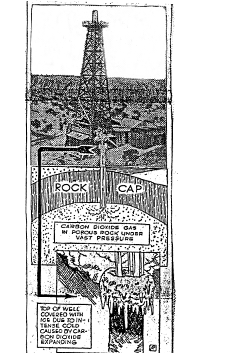
Dry Ice from Carbon Dioxide, 1930’s
Walking across a little log footbridge over Emigrant creek, pausing a moment to see the carbon dioxide gas bubbling incessantly from the tumbling stream, may in time—not too distant—become a mere memory to the hundreds who have visited Buckhorn lodge near the foot of the Greensprings mountain. Human power will probably harness the gas beds beneath the stream and its banks, necessarily removing the quaint bridge and its familiar surroundings.
Wealth, estimated at $2,000 per 24 hours that has been escaping in the form of gas may be realized materially if plans are completed for establishing a dry-ice plant at the resort. Active development was started about a month ago, although tests have been made over a two-year period.
Due to the exceptional value of such a product, action has been taken by Medford people interested in the development. A well has been drilled down 100 feet at the side of the creek for “mining” the product to be made into commercial ice.
Plans have been completed, however, for sinking the well 25 feet deeper, [please see editor’s footnote at the end] according to those in charge, whereby the supply of gas available is expected to be doubled, increasing the daily output from five tons, as now shown by tests, to 10 tons.
Dry ice is compressed or solid carbon dioxide 109.3 degrees below zero, Fahrenheit, said to be 15 times more efficient than ordinary ice.
When the gas is “not flowing”, it registers about 60 degrees F., but when “flowing”, due to expansion from enormous compression in the ground, a sub-zero condition is created.
From the springs at Buckhorn lodge, which is operated by Mr. and Mrs. C. W. McGrew, tests have been made by the natural gas investigation division of the federal bureau of mines, chemists, chemical engineers, and dry ice company officials, showing favorable reports from the samples.
The well, sunk 100 feet, is filled within five feet of the top with water, but the gas bubbles constantly above the opening. Monday morning Mr. and Mrs. McGrew bailed the water down 20 feet and the blue gas shot several feet above the ground, making a roaring noise, audible throughout the resort, they reported.
Parties in charge of the work stated that if the water could be removed to a lower depth, the pressure from the gas would probably keep the well free from water. The opening is stopped by an eight-inch gate. The greatest expense in converting the gas supply into the dry-ice product, would be the cost of erecting a compressor, Mr. McGrew stated.
Last Tuesday tests were made in compressing the gas into dry ice, and the experiment proved successful, even though the tests were made with the 95 feet of water in the well. The flow of gas registered by the meter 23,000 cubic feet in 24 hours.
Between 10 and 11 cubic feet of the CO2 gas are required to make one cubic foot of the dry ice, which is now obtained in Medford at a cost of 20 cents per pound from Portland. Mr. McGrew expressed the belief that after the compressor had been installed, the ice could be supplied in Medford at approximately a cent a pound.
Development of such a project in southern Oregon would revolutionize many industries. For so many uses have already been discovered for the gas. As such a small piece of the product (which does not melt, but evaporates) is required to cool a comparatively large area, the new ice has been considered ideal for shipping of fruit across the continent.
Mr. McGrew related an incident where one carload of pears was shipped from Medford to New York last season, packed in the dry ice, and a saving of 18 hours in transit was recorded, as there were no delays necessitated by icing. Only 600 pounds of the dry ice was used, where ordinarily 3600 pounds of common ice is required, he said. The lesser amount of ice increased the space available for fruit tonnage.
Mr. McGrew carried out a similar test on a smaller scale, whereby six ripe Bartlett pears were placed in the gas for a six months period. He reported them as being in as solid a condition at the end of that time as when stored.
Editor’s footnote:
The well was drilled 25 feet deeper as planned, however the carbon dioxide gas flow drastically decreased and was replaced by an artesian well. After heated discussions it was decided that the previous amount of CO2 obtained would be acceptable and a lead plug was inserted into the well to stop the flow of water. Unfortunately, or fortunately depending on ones perspective, the lead plug stopped everything and the project was abandoned.
Whal Opens Resort, 1936
Formal opening of the Buckhorn Mineral Springs resort is planned for March 15, Sunday, one week from today, it has been announced by F. E. Wahl, manager of the company. The mineral springs resort, formerly known as Tolman springs has been completely remodeled and renovated and now offers the most complete service of its kind in this part of the country, Whal said.
Buckhorn Mineral Springs are located 25 miles south of Medford on Emigrant creek. The springs are reached by turning left at the Klamath junction, following the Greenspring highway exactly three miles, and then turning right down the old road. Signs mark the route.
Included in the set-up are the ample lodge, bathhouses, springs with sulphur, oatmeal, soda and mineral water baths, hot medicated baths said to be good for the treatment of rheumatism, arthritis and similar ailments. Carbon dioxide gas vapor baths are also offered, beneficial in the treatment of asthma, catarrh, colds, sinus trouble, eczema and other skin diseases.
The staff includes Mrs. Amelia F. Toft, hostess; Dora Payne, nurse, and Clarence W. Finn, masseur in charge of baths. A graduate of St. Mary’s college in California, Finn, has had two years experience in hydrotherapy at the Veterans hospital in Palo Alto, California, five years experience at the General hospital in Los Angles, and has had considerable experience as masseur at Wilbur hotsprings at Williams, California, and is considered of outstanding ability, Whal said.
Finn follows the baths with mineral oil or alcohol massages and manipulations, as the case may indicate.
Mud baths are also offered at the resort. The mud, of a talc nature, is used for giving facials in many southern Oregon beauty parlors at the present time. The mud is also said to be beneficial in treatment of various skin eruptions when applied in packs.
The recently remodeled lodge includes the dining room and recreational quarters for guests, and there are 11 completely furnished apartments, including several which have been equipped for housekeeping.
A pamphlet now being prepared by the corporation headed by Whal will be released soon, giving detailed information regarding the medicinal and curative values of the springs.
The springs have an interesting history, having been discovered by the Chetko Indians hundreds of years ago, according to an interesting legend that has been handed down. The first white man to visit the place was Judge Tolman, southern Oregon pioneer, after whom the springs were named. Since their discovery by the white race, they have been visited by thousands from all parts of the country.